

As blockchain technology continues to evolve, Proof of Stake (PoS) has become the preferred consensus mechanism for many modern networks. Among them, Solana has established itself as one of the fastest and most scalable blockchains, capable of processing thousands of transactions per second while maintaining relatively low transaction fees.
For many newcomers, however, staking on Solana can seem confusing. Terms such as epochs, validators, delegation, and staking rewards often appear together, making it difficult to understand how the system actually functions.
This article explains how Solana’s Proof of Stake model works, what epochs are, how staking rewards are calculated, and why validators play such an important role in securing the network.
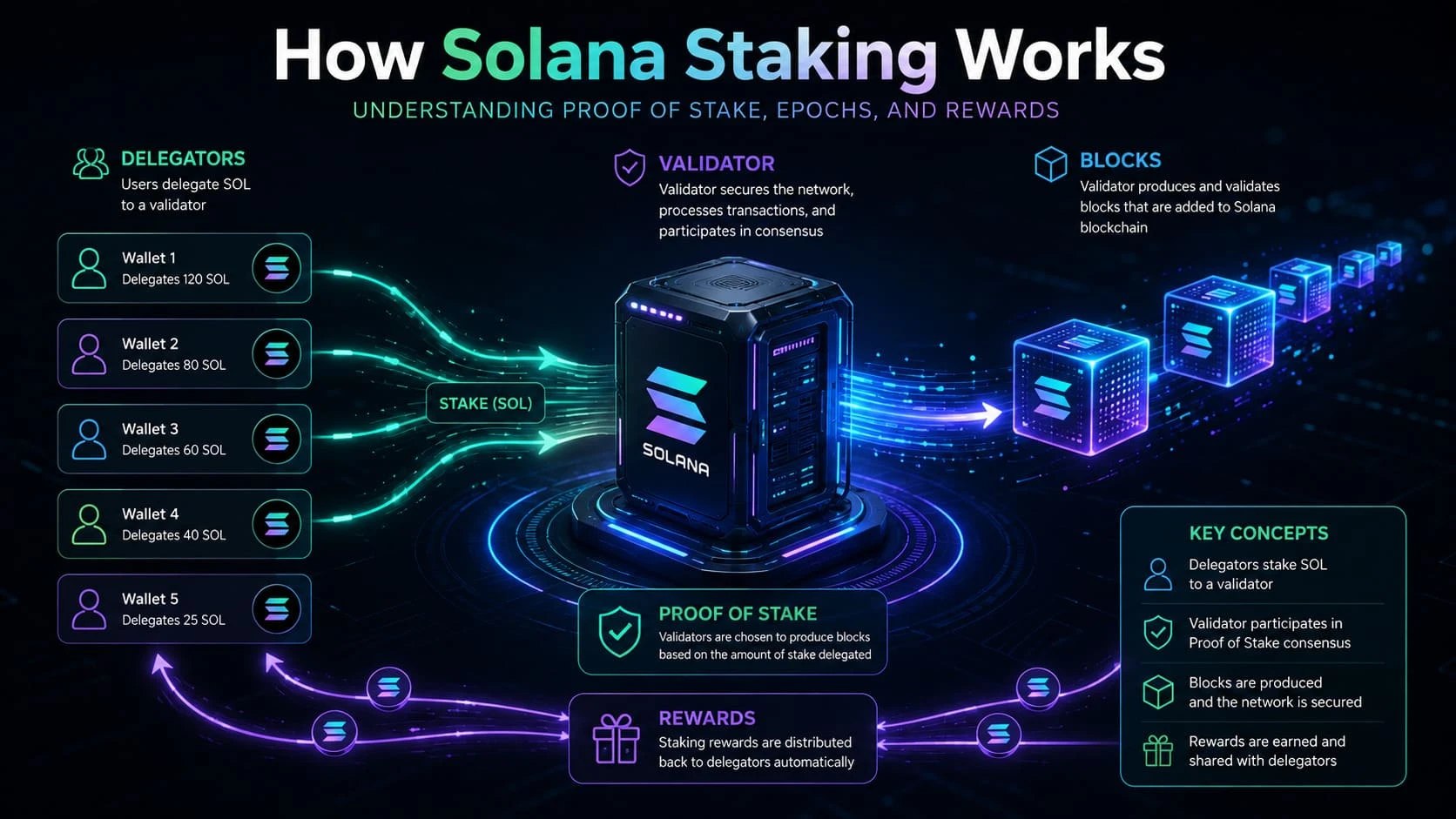
Understanding Solana Proof of Stake
Unlike Proof of Work blockchains, which rely on miners solving computational puzzles, Solana uses a combination of Proof of Stake (PoS) and its unique Proof of History (PoH) mechanism.
Proof of Stake determines who participates in securing the network, while Proof of History provides a cryptographic timeline that helps validators process transactions efficiently.
Together, these mechanisms allow Solana to achieve high throughput without requiring energy-intensive mining.
Instead of competing with computing power, validators compete by earning the trust of token holders who delegate their SOL.
Who Are Validators?
Validators are independent servers responsible for maintaining the blockchain.
Their responsibilities include:
- validating transactions;
- producing new blocks;
- participating in network consensus;
- voting on block validity;
- helping maintain decentralization.
Running a validator requires significant infrastructure, technical expertise, continuous monitoring, and high network availability.
Validators earn rewards for performing these tasks successfully.
What Is Delegation?
Most SOL holders do not operate validator nodes themselves.
Instead, they delegate their tokens to an existing validator.
Delegation does not transfer ownership of the tokens.
The validator never gains custody of the delegated SOL.
Instead, delegation simply increases the validator’s voting power within the network.
Your SOL remains under your control and can later be unstaked according to the network’s rules.
What Is a Solana Epoch?
One of the most frequently misunderstood concepts is the epoch.
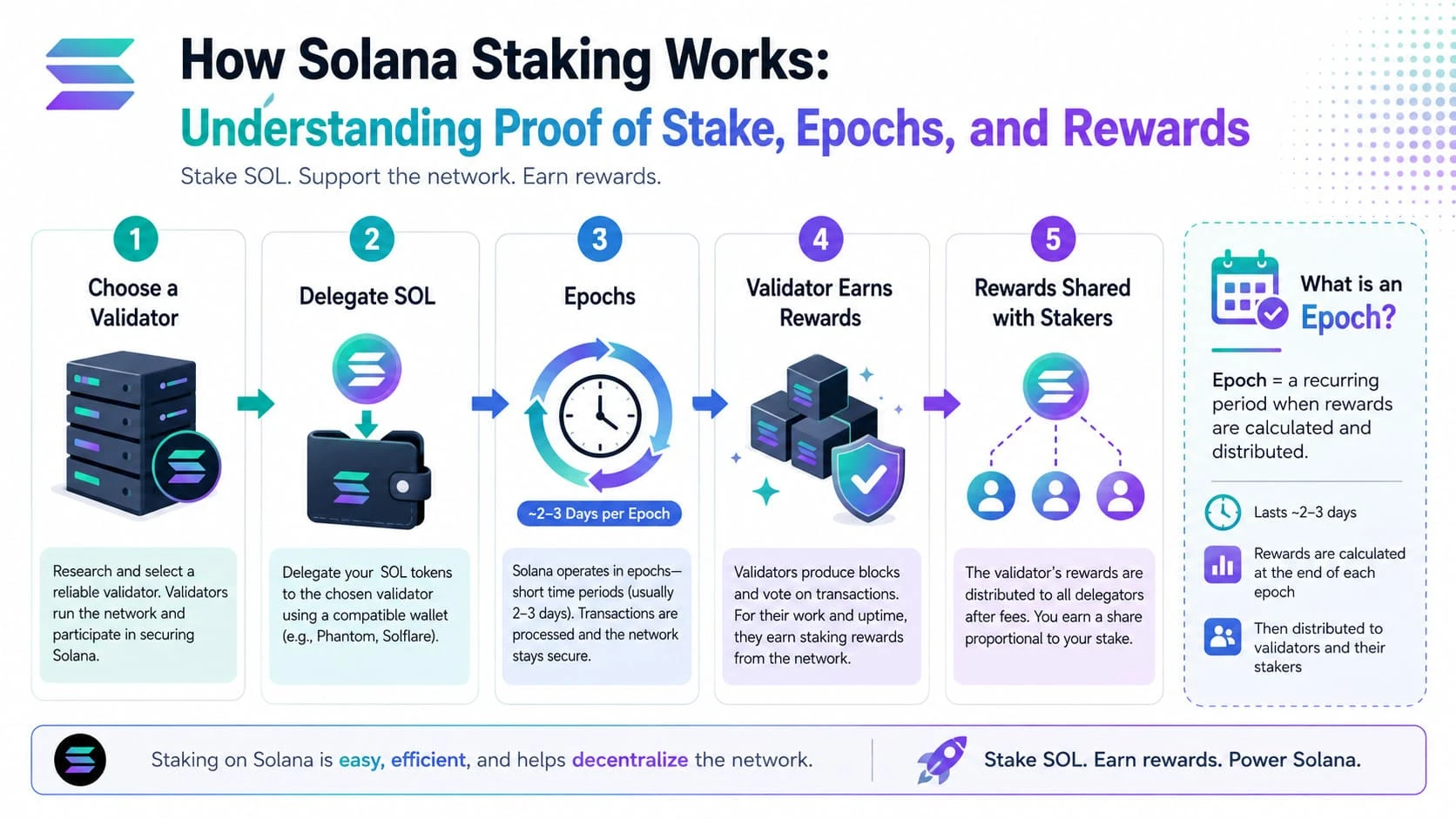
An epoch is a fixed period during which validator performance is measured and staking rewards are calculated.
Rather than distributing rewards after every block, Solana groups validator activity into epochs.
At the end of each epoch:
- validator performance is evaluated;
- voting participation is measured;
- staking rewards are calculated;
- rewards are automatically distributed.
This periodic structure keeps the reward system predictable while reducing unnecessary overhead.
Although epoch length can vary slightly depending on network conditions, it generally lasts around two to three days.
Why Does Solana Use Epochs?
Epochs provide an organized framework for network operations.
Instead of continuously recalculating staking balances, the blockchain performs accounting at regular intervals.
This provides several advantages.
Stable reward accounting
Reward calculations become simpler and more transparent.
- Validator performance measurement
The network can evaluate uptime and voting participation across an entire period rather than individual blocks.
- Efficient stake updates
New delegations and unstaking requests become active according to epoch boundaries, helping maintain consensus stability.
How Solana Staking Works
The staking process is relatively straightforward.
Step 1 — Acquire SOL
Users first obtain SOL tokens.
Step 2 — Choose a Wallet
Native staking is supported by wallets such as Phantom, Solflare, and hardware wallets like Ledger.
Step 3 — Select a Validator
Users review validator information before delegating their stake.
Common evaluation criteria include:
- commission rate;
- uptime;
- historical performance;
- community reputation;
- infrastructure reliability.
Step 4 — Delegate
Once delegated, the stake becomes active after the appropriate network transition.
No tokens leave the owner’s wallet.
Step 5 — Earn Rewards
At the conclusion of each epoch, staking rewards are distributed automatically according to validator performance and network rules.
How Are Staking Rewards Calculated?
Many newcomers assume staking generates a fixed interest rate.
In reality, staking rewards depend on multiple variables.
These include:
- total network stake;
- validator voting performance;
- commission percentage;
- protocol inflation;
- network participation.
As these variables change over time, staking yields also fluctuate.
Rather than promising guaranteed returns, Solana’s reward model adjusts dynamically according to overall network conditions.
Why Validator Performance Matters
Not all validators perform equally.
Validators with high uptime and consistent voting participation generally produce better long-term outcomes for delegators.
Important characteristics include:
Reliability
Validators should remain online continuously.
Downtime may reduce rewards.
Infrastructure
Professional operators typically deploy redundant hardware, monitoring systems, backup networking, and automated alerts.
Commission
Validators receive a percentage of generated rewards as compensation for operating their infrastructure.
Lower commission means delegators retain a larger portion of rewards, although commission alone should never be the only selection criterion.
Understanding Compounding
One of the most valuable aspects of staking is compounding.
Each epoch produces additional SOL.
As rewards accumulate, future rewards are calculated using a larger staking balance.
Although each individual reward may appear relatively small, long-term compounding gradually increases the overall amount of delegated SOL.
Investors who maintain long staking horizons often benefit more from this effect than those attempting to trade frequent market movements.
Common Misconceptions About Epochs
Several misconceptions frequently appear among new users.
“Rewards arrive every day.”
Rewards are generally distributed at epoch boundaries rather than daily.
“Changing validators loses rewards.”
Changing validators follows network rules but does not erase previously earned rewards.
“Epochs are fixed calendar periods.”
Epoch duration depends on network operation and therefore may vary slightly.
“Higher APY always means better staking.”
Yield is only one consideration.
Reliability, transparency, and long-term consistency often matter more.
Security Considerations
Native staking on Solana is designed to be non-custodial.
Validators cannot spend delegated funds.
However, users remain responsible for protecting:
- wallet recovery phrases;
- hardware devices;
- private keys;
- transaction approvals.
The greatest security risks usually come from phishing attacks or compromised wallets rather than the staking mechanism itself.
Choosing a Validator
Selecting a validator involves balancing several factors rather than focusing on a single number.
Experienced delegators often review:
- uptime statistics;
- commission stability;
- infrastructure quality;
- operational history;
- communication transparency;
- community reputation.
Independent validators play an important role in maintaining decentralization by distributing stake across a broader set of network participants rather than concentrating it among only the largest operators. Ongoing initiatives within the Solana ecosystem also encourage transparency and responsible validator operations through programs and publicly available performance data.
A Practical Example
One example of an independent operator is Validator Vladika. Like many professional Solana validators, it provides public information about its validator operations, commission policy, and staking process, allowing prospective delegators to review these details before making a decision. The availability of transparent operational information can help users compare validators using objective criteria rather than relying solely on advertised yield.
Regardless of which validator is ultimately selected, reviewing publicly available performance metrics, operational history, and infrastructure practices is an important part of responsible staking.
Long-Term Participation
Many investors initially approach staking as a way to generate passive rewards.
Over time, however, staking also becomes a method of participating in the security and decentralization of the Solana network.
Delegators help determine how voting power is distributed across validators.
Their choices influence the health, resilience, and diversity of the ecosystem.
This makes validator selection more significant than simply comparing annual percentage yields.
Conclusion
Solana’s staking model combines Proof of Stake with Proof of History to create a network capable of processing transactions quickly while remaining decentralized.
Epochs provide the framework through which validator performance is measured and rewards are distributed, allowing the network to maintain predictable accounting and stable consensus.
Understanding how epochs work, how rewards are calculated, and why validator quality matters enables investors to make more informed staking decisions.
Ultimately, successful staking is less about chasing the highest advertised return and more about selecting reliable infrastructure, maintaining long-term participation, and understanding the mechanics that secure one of the world’s fastest blockchain networks.